
In January 2025, the Shell GameChanger Accelerator™ Powered by the National Laboratory of the Rockies (GCxN) chose two winners for its first Channel Partner Strategic Awards cycle. The funding provided from this award addresses commercialization gaps for energy startups through regional collaboration and tailored entrepreneurial support.
Here is the story of how one winning team made an impact through action-oriented initiatives and partnership creation.
American actors tend to congregate in Hollywood, bankers in Wall Street, and entrepreneurs in Silicon Valley. But Ken Hayes wants to make geography irrelevant to success—at least for energy entrepreneurs.
“We want entrepreneurs to stay in their local communities and build prosperity but have access to the rest of the world,” said Hayes, the executive director of Cleantech Open (CTO), a national business accelerator that has worked with more than 4,000 startup founders since it launched in 2005.
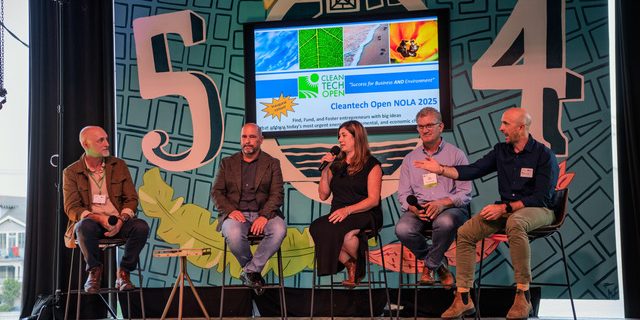
Now, thanks to a 2025 GCxN Channel Partner Strategic Award, CTO has expanded into a new region, the Gulf Coast. The national organization partnered with Deep Blue Institute, a New Orleans-based group that supports startups working on technologies that could tackle specific Gulf Coast challenges, like dwindling clean water supplies, thrashing storms, and coastal erosion.
“Louisiana is losing a football field of land every 90 minutes [due to erosion],” said Greg Delaune, the cofounder and managing director of Deep Blue Institute.
Some local startups have come up with workarounds—like floating homes, recycled chemicals, water-saving irrigation, and storm-resistant roofs—that could help Gulf Coast communities persist through future catastrophes. And Hayes and Delaune aim to help these startups advance their ideas without having to transplant their businesses—and their workforce and economic benefits—outside their community. The GCxN Strategic Award is enabling them to do just that: support young companies to chase success right at home in the Gulf Coast.
“These startups are at a very vulnerable stage,” Hayes said. “They’re on to something, they know they’re onto something. And we give them a window to the world.”
A Window to the World
This year’s award funding supports Gulf Coast-based entrepreneurs, specifically, to gain the attention and funding needed to grow their business. In the Gulf Coast region, Delaune said, “It’s harder to get investors, it’s harder to get momentum. And we’re filling that gap.”
In March 2025, CTO and Deep Blue Institute co-hosted a New Orleans recruiting event for startup founders and took on five of the companies that applied to join their accelerator program.
Entrepreneurs from those five startups then attended CTO’s three-day educational event: the National Academy West, in Los Angeles. GCxN award funding helped cover some of the founders’ travel costs—an expense that, in the past, has prevented some from accessing CTO’s support.
Once in Los Angeles, the founders attended workshops on how to develop a business model, elevator pitch, and go-to-market strategy; identify potential customers; and secure funding. They also had the chance to chat strategy with CTO alumni.
“The Cleantech Open event gave us a chance to practice pitching our product, often to complete strangers who we had no prior connection with,” Daisy Dodge told a local news outlet. Dodge founded FLOAT Modern Houseboats, which sells floating, off-grid, modular homes (called “fish camps” down in the Gulf, according to Delaune).
“We’re really about getting these companies from zero to one,” said Delaune. “Daisy Dodge is a great example. She’s been kind of noodling with her idea for 10 years, but this [support] got her from zero to one.”
Next, back in New Orleans, in October 2025, the founders participated in three days of customer discovery interviews. They collected feedback regarding potential customers’ needs and pain points to determine how their products could help. The five Louisiana startups—plus an additional five from out of state—gathered to hear presentations from New Orleans-based experts in the blue economy (the responsible use of ocean and coastal resources to build jobs, industries, and communities).
Blue economy tech includes Dodge’s fish camps as well as the other startups’ tech, including waterborne microplastics cleanup, smart sprinkler systems that cut waste and cost, graphene (a high-demand material used in modern electronics, medical equipment, and more) made from waste chemicals pulled from water, and roofs that can survive a hurricane.
“These technologies are critically needed for the coming decades and could be a way to diversify Louisiana towards long-term growing sectors that are high value,” Delaune said.
The World’s Window to New Orleans
In the final months of CTO’s five-month accelerator program, the entrepreneurs submitted a final business plan and pitched it to a panel of mock judges. They also participated in a regional pitch competition and flew to San Jose, California, to attend CTO’s Global Forum event where they pitched live to the public and met one-on-one with hand-picked investors.
Throughout the entire program, each startup also received tailored support from pro-bono mentors, who worked with them for about two to four hours per week.
“We’re not doing the work for them,” Hayes said. “We’re coaching them on how they can best show off what they’re doing and build the evidence they need to convince investors and other partners that they really are onto something.”
On November 6, CTO and Deep Blue Institute co-hosted a New Orleans Showcase—the final event of their GCxN award. There, the five startups gathered with Gulf Coast-based executives and entrepreneurial leaders to deliver curated pitches and receive informal feedback, celebrate their accomplishments, and plan for 2026. But the startups’ journeys with CTO didn’t end there. As alumni, they can still access the organization’s resources into 2026 and beyond.
Next, CTO and Deep Blue Institute hope to support more Gulf Coast-based founders and potentially expand up the Mississippi River, too.
“We want to build the narrative that if the rest of the world is looking for the best coastal solutions, New Orleans is the place to come,” Delaune said. “And Cleantech Open in New Orleans is the organization you want to work with.”