
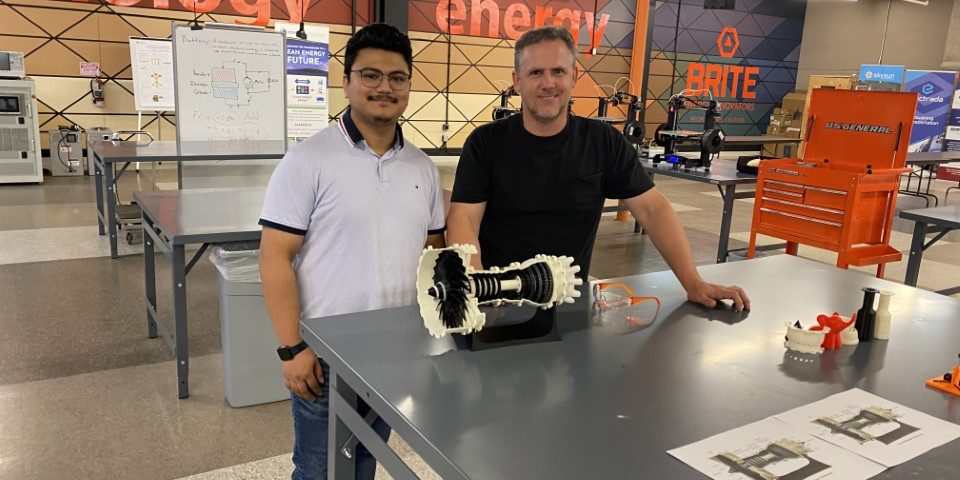
BRITE, an Ohio-based incubator accelerating energy technologies, was one of two winners of GCxN’s first-ever Channel Partner Strategic Awards in January 2025.
In January 2025, the Shell GameChanger Accelerator™ Powered by the National Laboratory of the Rockies (GCxN) chose two winners for its first Channel Partner Strategic Awards cycle. The funding provided from this award addresses commercialization gaps for energy startups through regional collaboration and tailored entrepreneurial support.
Here is the story of how one winning team made an impact with action-oriented initiatives and partnership creation.
On November 5, 2025, Kellen Francis sat in an auditorium in Baton Rouge, Louisiana, waiting to hear the name of the next winner. The startup founder, who claims he has a “disgusting level of drive,” was attending the state’s inaugural Energy Awards. When he heard the announcers call his company’s name as the winner of the Emerging Energy Leader award, he was so surprised, he almost didn’t react at all.
“Yes I’m still in shock if [anybody] is wondering,” Francis posted on social media shortly after learning he won. “I can’t wait to see what’s next!! The Marathon Continues.”
Francis earned his win, in part, thanks to guidance from Nexus Louisiana (Nexus). Nexus supports entrepreneurs—specifically those homegrown in Gulf Coast states, like Louisiana—to launch their technologies out of obscurity and into the market. With funding from a GCxN Channel Partner Strategic Award, Nexus Louisiana recently partnered with BRITE, another Channel Partner organization, and expanded their support for Gulf Coast-based entrepreneurs, thinkers, and tinkerers, like Francis.
“We’re helping companies get out of the lab and build a business beyond just a great product,” said Manoj Jhaveri, BRITE’s innovation services director.
The 2025 cycle of the GCxN Strategic Awards—also the inaugural cycle—focused on building support for Gulf Coast entrepreneurs, in particular. Ohio-based BRITE won the award and then partnered with Nexus Louisiana, which is based in Baton Rouge, Louisiana, to expand their reach. Nexus staff know the Gulf Coast region—its hidden masterminds, the different paths a young company can take, and the waste and energy challenges their communities are facing right now.
“We’ve created a pipeline that lets us foster talent right here in Louisiana,” said Tony Zanders, the president and CEO of Nexus Louisiana. “Founders who were born and raised here can help solve some of our region’s—and, honestly, the world’s—biggest challenges.”
Thanks to the GCxN Strategic Award, BRITE’s nationally focused team gained a stronger presence in the Gulf. Nexus’ team recruits the hidden masterminds and helps them get started with a business plan, customer discovery, and investor pitching. Once the company gains momentum, BRITE’s executives step in—literally.
“We embed ourselves in companies and help them take that next journey,” Jhaveri said. “It could be marketing, finance, fundraising strategy, operations, manufacturing, supply chain—a host of different ways.”
Although BRITE and Nexus Louisiana planned to support a minimum of 10 founders over their year-long award, they brought on 12 in just six months.
Twelve Startups, 30 Executives, and Hundreds of Investors
When BRITE and Nexus Louisiana first partnered up, the Nexus team first tracked down potential founders, like academic inventors, promising startups that escaped to other states, or engineers and computer scientists who built something and weren’t sure what to do with it. Then they met with each promising mastermind to identify potential customers, validate their business models, explore investor interest, and build a solid prototype.
Ten of the twelve companies are just starting to explore their technology’s potential with Nexus Louisiana. Six have completed initial qualification, meaning they’re ready to explore customers and investors, and four have gained enough traction to progress to the next phase: BRITE.
“Every startup has gaps,” Jhaveri said.
BRITE—and its network of more than 30 fractional executives and marketing specialists—helps fill those gaps. The team identifies key operational bottlenecks, strengths and weaknesses, and the types of targeted support a company might need. The company then receives that support from executives who function as full-time employees. These embedded consultants help companies strategize how to market or finance their product, communicate with investors, pursue other funding opportunities, navigate manufacturing and supply chains, and more.
The BRITE consultants also make what Jhaveri calls “warm introductions” to potential investors—the organization has hundreds in their venture network.
With the GCxN award, Nexus Louisiana and BRITE enlisted more than 12 external partners, including Shell, Chevron, the College of Engineering at Louisiana State University, and governmental and nonprofit organizations, such as Louisiana Economic Development, Future Use of Energy in Louisiana, and more.
Thanks, in part, to support from BRITE and Nexus Louisiana, several of the 12 startups are already exploring pilot projects, supply chain partnerships, and early customer opportunities that could lead to purchase agreements within the next 6–12 months.
And one startup, founded by Francis, just brought in $2 million.
Remote Repair, Portable Power, Captured Chemicals, and Virtual Replicas
Not only did the Louisiana-based startup CodeGig raise $2 million; the young company also won Louisiana’s Emerging Energy Leader category.
CodeGig’s founder, Francis, was Nexus Louisiana’s first recruit. The startup created software that can help energy companies virtually diagnose and repair potential problems. Another company, Nova Spark, developed a portable power system for military and other applications and is close to raising $2 million. Encore CO2, which turns captured carbon dioxide into sellable chemicals (like pharmaceuticals, clothing, and seltzer), is also vying for investment.
“Louisiana has the most important raw ingredients for innovation: real-world problems and experts to solve them,” Zanders said in an article on Nexus Louisiana’s DevDays event.
Louisiana already has a big energy industry footprint. The state hosts many oil and gas companies and petrochemical plants. But it also has room to grow. Artificial intelligence could streamline energy operations. Abundant waste chemicals could transform supply chains and open new markets. And more versatile energy options could power up military-related activities and jobs in the region. Between 2024 and 2025, Louisiana brought in close to $44 billion in energy-related investments, according to Louisiana Economic Development.
The state could continue to grow that number, especially if it can boost early-stage funding for startup founders, coordinate support for these budding entrepreneurs, and help prevent talent from being swept away by out-of-state competition, according to Zanders.
“We’re losing talent every year to out-export and brain drain,” Zanders said. “Bright engineers either leave Louisiana for bigger markets or take the safe route because they do not see a clear path to build here.”
One way Nexus Louisiana is trying to reverse the brain drain is through its DevDays event. In this statewide competition, engineering and computer science students design potential solutions for real challenges that Louisiana industry partners are facing. Student teams compete to win $10,000 in cash prizes, network with industry leaders, and (hopefully) get a glimpse of a clear path to building a company in Louisiana.
“Our job,” Zanders said, referring not just to DevDays students but to all Louisiana-based entrepreneurs, “is to create more shots on goal by exposing talent early to the hardest, most urgent problems and giving them the support to solve them at home.”
Kellen Francis and CodeGig are evidence that Nexus Louisiana and BRITE’s strategic support can work—and already has. “Louisiana has proven we can recruit technology companies,” said Zanders. “But we still have work to do.”
Comments are closed.